
Madex · Consultancy project · 2025
AI Product development co-pilot

Role
CX Designer / Researcher
Duration
12 Weeks
Responsibilities
UX Research
UX Design
Business Strategy
Product Strategy
Tools
Figma
Miro
Airtable
Context
We set out to fix advertising. The real problem was upstream
Madex wanted to change how advertising worked for a web3 future. The brief was intentionally open—not “build this product,” but “find where the real value is.”
We began by investigating waste and inefficiency across the advertising pipeline. Over twelve weeks, the evidence moved us upstream: products were frequently failing before advertising even began because teams lacked a fast, affordable way to test whether people wanted them. This lead up to develop LAILA—an AI-powered co-pilot that uses synthetic consumer panels to help teams test and refine product decisions in real time.
The initial brief
We began by looking for pain in advertising
We began by exploring why 75% of new products fail. Our initial hypothesis focused on advertising inefficiency, but we kept the research broad to identify the real problem before committing to a solution.
Millions of new products launch every year yet 75% fail.
$553bn is wasted every year;
paying people, manufacturing and advertising.
This project was born from a desire to change the way that people interact with advertisements in our modern and changing world. We started with this opportunity statement to explore the space.
Our Starting Hypothesis
We believed that companies have products fail due to a lack of reach or optimisation within their advertising campaign
Understanding an opportunity
Understanding the product
20 Open Ended Interviews + SME workshop across stakeholders
Marketing Managers, Analysts, Social media Specialists
Twenty interviews and an SME workshop with top marketing professionals helped us explore advertising’s role across the product lifecycle. We found that advertising problems often originated earlier, from deeper issues in product development.
SME Workshop


Advertising wasn’t the root problem.
Products were often being promoted before teams had established whether consumers wanted them.

Fragmented system
Advertising involved multiple stakeholders with competing interests, making alignment slow and difficult.
Ineffective targeting
Existing methods frequently resulted in poor targeting and wasted advertising budgets.
Inaccessible research
Traditional consumer testing could cost between $10,000 and $70,000, preventing smaller teams from testing and iterating regularly.
Framing the new opportunity
How might we help product teams test and improve ideas before committing to launch?
Traditional consumer research was valuable, but its cost and delay often restricted it to one late-stage checkpoint—when changing direction was already expensive.

Products fail because companies struggle to build products people actually want, often missing alignment with real consumer needs and market demands.
What if we could help companies develop products consumers actually want?
The pivotal insight
Advertising failure was often product failure in disguise
43 Open Ended Interviews across stakeholders
Product Managers, Product Owners, COOs, Product Innovation
A further discovery interviews revealed the deeper problem: companies were committing to products before adequately establishing whether people wanted them.
Lack of Agility
Slow development means missed trends and outdated products.
Mismatch with Consumer Needs
Products fail when flawed research misses real consumer needs.
Resource and Time Intensity
Product development is too slow and costly for effective iteration.
Inefficiency in Testing
Consumer testing is slow, costly and often produces poor insights.
Opportunity Strategy
Value proposition testing
44 Value Proposition Interviews across stakeholders
Product Managers, Product Owners, COOs, Product Innovation
The research revealed opportunities across discovery, intelligence, automation and consumer testing. We developed ten propositions, then tested them across 44 interviews rather than committing to the first plausible answer.
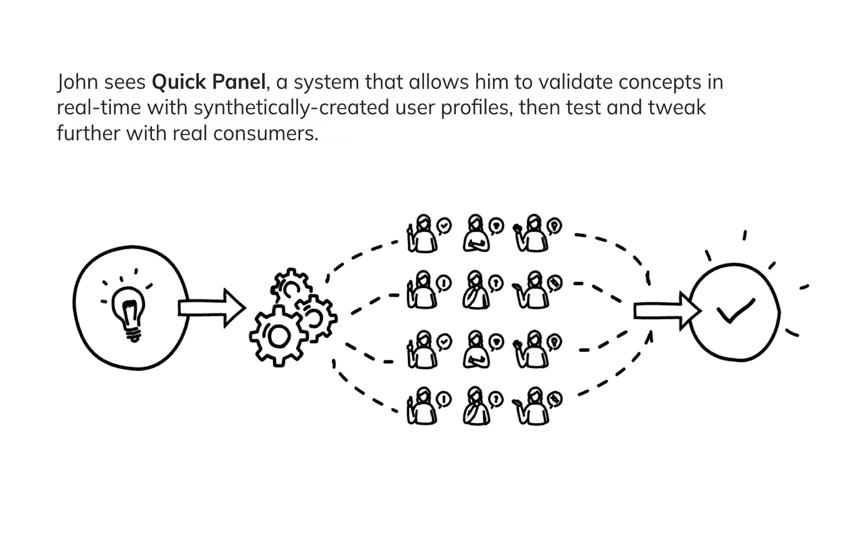
Stakeholders selected Quick Panel as the strongest proposition—an AI-powered system offering faster, more affordable consumer testing without traditional research delays.
Testing before building - Quick Panel
A landing page before a product
We turned Quick Panel into a landing page and lightweight working concept. Across 73 solution and wireframe interviews, we really wanted to understand was if users would trust a synthetic AI powered user to give them feedback and results on their product.

9/10
Product Owners are comfortable talking to
Virtual Consumers
“I have no problems talking to Virtual Consumers at all personally, and I think people in this space would feel the same.”
Head of Innovation, John Lewis
Pressure testing the concept - Gemi
The concept earned enough confidence to prototype
73 Solution / Wireframe Interviews across stakeholders
Product Managers, Product Owners, COOs, Product Innovation
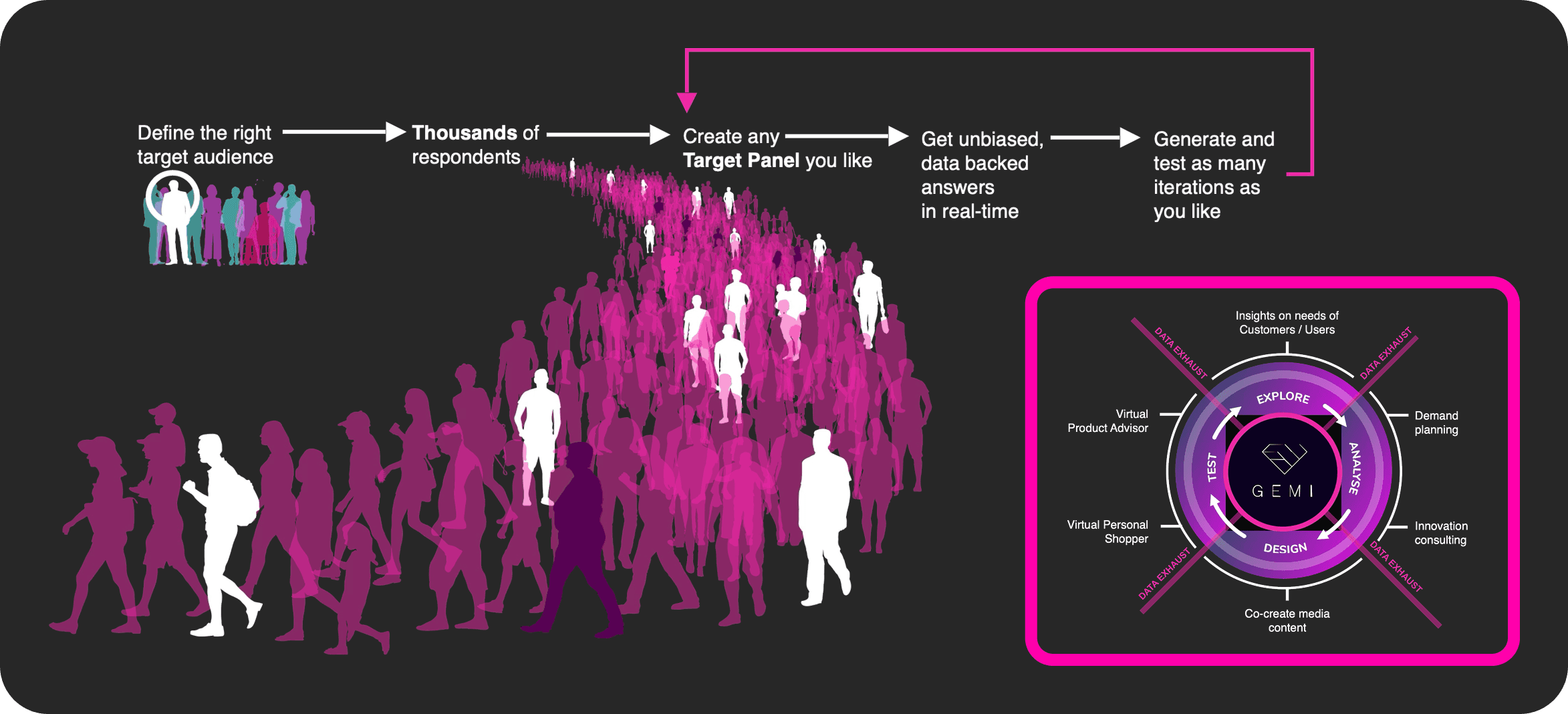
Before building the polished UI, we put a working proof-of-concept in front of 73 stakeholders — product owners who run concept research the slow, expensive way — and had them react to synthetic-consumer results on live concepts. The signal came back strong enough to commit to the build.
The Product Vision
An AI co-pilot for better decision-making across every stage of product development
The product, now called LAILA, gives teams continuous access to synthetic consumer insight, helping them explore opportunities, test concepts and refine ideas earlier. The first release focused on exploratory research and concept testing—guiding users from a research question to actionable recommendations.
Development
Turning the proposition into a usable workflow
Before designing a finalised interface, we mapped two core user flows—idea exploration and concept testing. These flows and the product roadmap then guided feature priorities, wireframes and high-fidelity prototypes.


Designing the MVP
From a research question to actionable consumer insight
We mapped the exploratory research and concept-testing journeys before moving into interface design. The final workflow helped teams define what they needed to learn, shape a study and review the resulting consumer evidence.
The power of product research from your desktop

A guided consumer-research workflow
A short walkthrough can show the complete journey—from choosing a research method to reviewing the final findings.
Four moments in the final experience
01 - Frame
Start with the right research method
Separating exploratory research from concept testing at the outset gave each journey a clear purpose and allowed the platform to guide the user appropriately.
02 - Refine
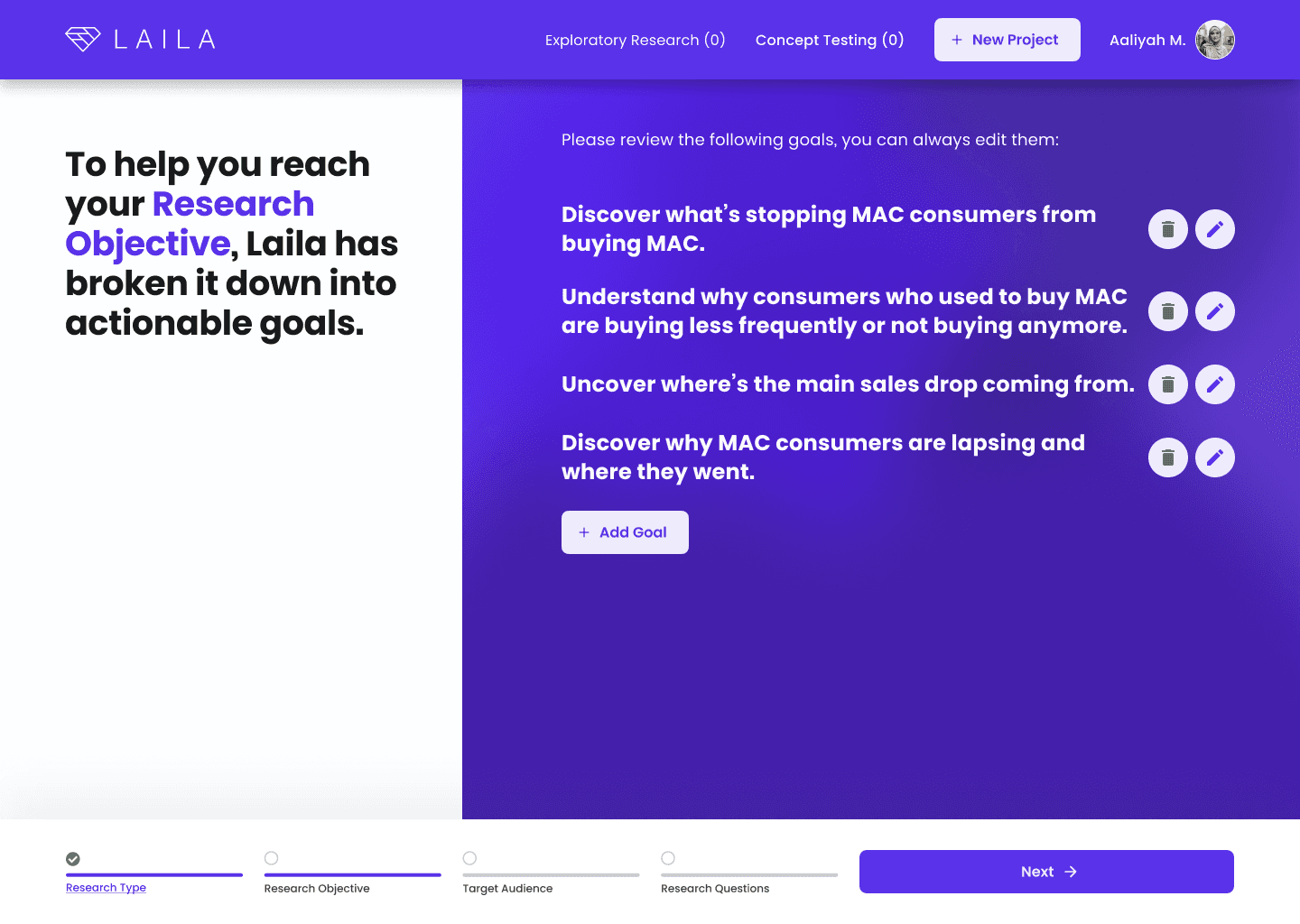
Turn a broad objective into actionable goals
LAILA translated the initial research objective into a set of focused goals. Users could review, edit, remove or add goals before continuing.

03 - Define
Build the study in manageable steps
The workflow progressively captured the target audience and research questions, keeping a complex setup process focused on one decision at a time.
04 - Decide
Bring the evidence together
The results view combined comparative measures, rankings, key insights and recommendations so teams could evaluate concepts and identify what to refine next.

Design principle
Use AI to structure the research process while keeping users in control of the goals, audience and questions shaping the study.
Outcome
Validated, not shipped
The team left before release, so there are no launch metrics. But our final direction and MVP earned solid validation:
9.1/10
Net promoter score on the proposed solution
9.3
Pain score for solving product research issues
9/10
comfortable talking to synthetic customers
Reflection
This project taught me that a wrong path can still reveal the right opportunity. Listening closely and looking beyond surface-level feedback revealed the insight that changed the direction of the venture.
Have a new project or just want to say hi!
Feel free to reach out to me.
Works
About
Playground
Say hello
© 2026 - Marcus Ostler
Like any product this portfolio website will continue to evolve. Please check back regularly!
(V1.0)